


The All Progressives Congress (APC) has declared that its estimated 13 million registered members, extensive grassroots network and dominance in elective positions across the country place it at a significant advantage over other political parties ahead of the 2027 general elections.
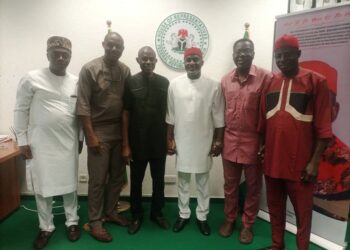
The National Chairman of the party, Professor Nentawe Goshwe Yilwatda, stated this while receiving a pre-election fact-finding mission of the Economic Community of West African States (ECOWAS), led by former Vice-President of Sierra Leone, His Excellency Victor Bockarie Foh, at the APC National Secretariat in Abuja over the weekend.


Yilwatda, who received the delegation alongside members of the party’s National Working Committee (NWC), said the APC had developed a formidable political organisation with structures and membership spread across all parts of the country, giving it considerable capacity for voter mobilisation and electoral competition.
In a statement issued by his Special Adviser on Media and Information Strategy, Abimbola Tooki, the APC chairman explained that the party’s strength went beyond its electoral victories, stressing that its verifiable membership database, grassroots structures, elected representatives, support groups and established internal processes distinguished it from other political parties.
“Our party is the largest political party in Nigeria. In terms of structure, organisation and membership, no other political party comes close to us. We are approximately three times larger than the next political party in the country,” he said.
He disclosed that the APC had approximately 13 million registered members across the 774 local government areas, supported by detailed membership records and identification cards designed to facilitate verification through National Identification Numbers (NIN) and voter identification details.
According to him, the database provides a reliable foundation for grassroots engagement, political mobilisation, internal coordination and strategic electoral planning.
Yilwatda further revealed that the party maintained more than 261,000 executive members across its organisational hierarchy, with functional structures extending from wards and local governments through state chapters to the national level.
He said the extensive network enabled the APC to sustain direct contact with members and supporters at the grassroots while coordinating political activities and campaign strategies nationwide.
Highlighting the party’s representation in elective offices, the chairman disclosed that the APC controlled 31 of Nigeria’s 36 states, had 88 senators in the 109-member Senate and 208 members in the 360-member House of Representatives.
He added that the party also enjoyed substantial representation in state Houses of Assembly, describing its numerical strength in government as evidence of its political reach and acceptance across the country.
According to him, the elected officials provide the party with an extensive leadership network capable of connecting government policies with citizens and mobilising support at federal, state and local government levels.
The APC chairman also identified the party’s organised support groups, including youth, women and persons with disabilities, as critical components of its nationwide mobilisation machinery.
“These structures are the foundation of our strength. We have built an organisation that reaches every part of the country and gives us the capacity to engage Nigerians across different demographics,” he said.
On the party’s internal electoral processes, Yilwatda disclosed that more than 7,000 aspirants contested for various positions on the APC platform ahead of the 2027 general elections.
He described the high number of aspirants as a demonstration of the confidence politicians reposed in the party and the competitiveness of its primary elections.
Despite the intense contests, he said the APC had recorded relatively few post-primary court cases, attributing the development to efforts to manage internal disagreements and resolve disputes arising from the selection process.
He also noted that some politicians who failed to secure the APC tickets subsequently obtained nominations from opposition parties, including the African Democratic Congress (ADC) and the Nigeria Democratic Congress (NDC).
Yilwatda argued that the development further demonstrated the attractiveness of the APC platform and the intensity of competition for its tickets.
He maintained that the party’s advantage was also reinforced by the experience and political loyalty of many of its members, particularly those who had maintained longstanding relationships with the party.
The chairman further claimed that the APC had demonstrated greater preparedness for the forthcoming elections by presenting candidates for all elective positions it was contesting.
He contrasted the development with what he described as difficulties encountered by some opposition parties in fielding candidates for certain positions and completing their nomination processes.
According to him, the APC had released and inaugurated its campaign council, commenced campaign activities and uploaded its candidates to the Independent National Electoral Commission (INEC) portal ahead of its rivals.
He, however, urged INEC to adhere strictly to its published electoral timetable, insisting that the rules must apply equally to all political parties to guarantee a level playing field.
“We believe INEC should stick to its timetable. The rules must apply equally to every political party. The electoral process must be fair, transparent and predictable, without adjusting deadlines in a manner that gives any party an undue advantage,” he stated.
Despite projecting confidence in its organisational and numerical advantage, Yilwatda said the APC did not consider electoral victory automatic, noting that its preparations were anchored on organisational capacity, candidate readiness and nationwide mobilisation.
He also assured the ECOWAS delegation that the ruling party remained committed to democratic competition and would not exploit its political dominance to undermine opposition parties.
The APC chairman maintained that all political parties should have equal opportunities to access the media, use campaign venues and communicate their programmes to Nigerians without intimidation or discrimination.
Citing public demonstrations against President Bola Ahmed Tinubu’s administration, including the “Tinubu Must Go” protests, he argued that the existence of such demonstrations showed that citizens and opposition groups could express dissenting views without automatically facing arrest or intimidation.
He said a ruling party confident in its strength should be willing to operate within democratic principles while protecting the political space for opposing views.
“Being the largest political party does not mean that we want to suppress anybody. We want a democratic environment in which every party can organise, campaign and seek the support of Nigerians without fear,” he said.
Yilwatda further noted that the APC understood the dynamics of democratic competition, having experienced electoral defeats in previous elections.
He cited the political engagements and realignments that followed the party’s defeats in the Anambra and Osun governorship elections as examples of how electoral setbacks could lead to consultations, cooperation and broader political alliances.
According to him, such engagements had contributed to wider political cooperation in support of President Tinubu’s re-election bid.
Earlier, the leader of the ECOWAS pre-election fact-finding mission, Victor Bockarie Foh, said the delegation was in Nigeria to assess the political environment and gather relevant information that would contribute to the conduct of free, fair and transparent elections in 2027.
Foh explained that the mission’s assessment would be guided by systematic observation, verification and the collection of credible data rather than assumptions or arbitrary conclusions.
“Our monitoring is scientific, and our decisions on issues are based on scientific observation. We verify information before making any pronouncement, and we use a robust application system to collect data. Our reports are therefore not arbitrary,” he said.
He noted that the delegation was engaging political parties and other relevant stakeholders to obtain information and perspectives necessary for a comprehensive assessment of Nigeria’s electoral environment.
Foh commended Yilwatda for the detailed briefing, saying the presentation had provided the mission with valuable insight into the APC’s organisational structure, membership strength, internal processes and preparations for the 2027 elections.
He expressed confidence that the engagement would contribute to the mission’s understanding of the country’s political landscape and the conditions under which the forthcoming general elections would be conducted.